Aspect-Based Sentiment Analysis
Co-authored undergraduate research on instruction-tuning open LLMs to extract the aspects a review talks about and classify the sentiment expressed toward each one.
- Focus
- Machine Learning, NLP Research
- Core stack
- PyTorch, Hugging Face Transformers, QLoRA/PEFT
- Context
- Co-authored undergraduate research2 authors
“The pastapositive was excellent, but the servicenegative was painfully slow.”
- Aspect term extraction
- Aspect sentiment
Research question
Sentiment, one aspect at a time
A review rarely has one sentiment. “Great food, terrible service” is positive about one thing and negative about another, and a single document-level label throws that away. Aspect-based sentiment analysis recovers it in two steps: find the aspects being discussed, then classify the sentiment toward each.
This co-authored undergraduate research asked how well open, instruction-tuned LLMs handle both steps when fine-tuned with parameter-efficient methods, compared across two model families and two review domains.
Task 1 · ATE
Aspect term extraction
“The battery life is great but the keyboard feels cheap.”
Task 2 · ASC
Aspect sentiment classification
- battery life
- positive
- keyboard
- negative
Method
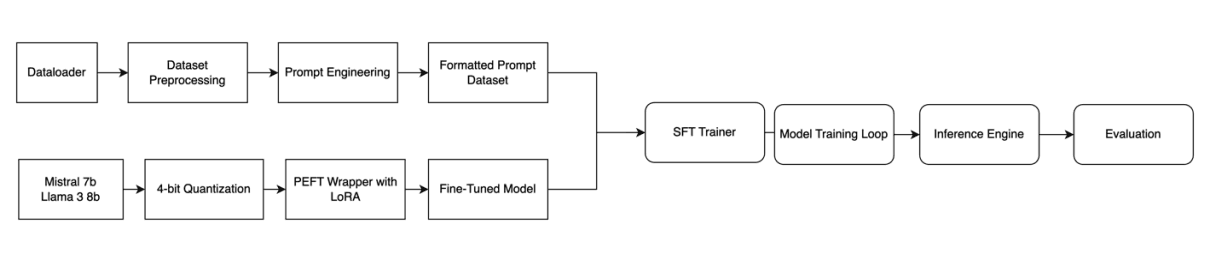
Instruction tuning with QLoRA
Framing
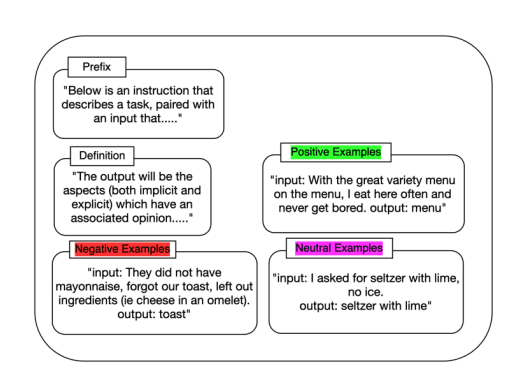
Both tasks were rewritten as instructions: a task definition followed by positive, negative and neutral worked examples, then the review to analyse. The model learns to produce the answer in a fixed format that can be parsed and scored.
Training
Base weights are loaded in 4-bit precision and only small LoRA adapter matrices are trained (QLoRA, via Hugging Face PEFT and a supervised fine-tuning trainer). That keeps memory requirements low enough to fine-tune 7–8B-parameter models.
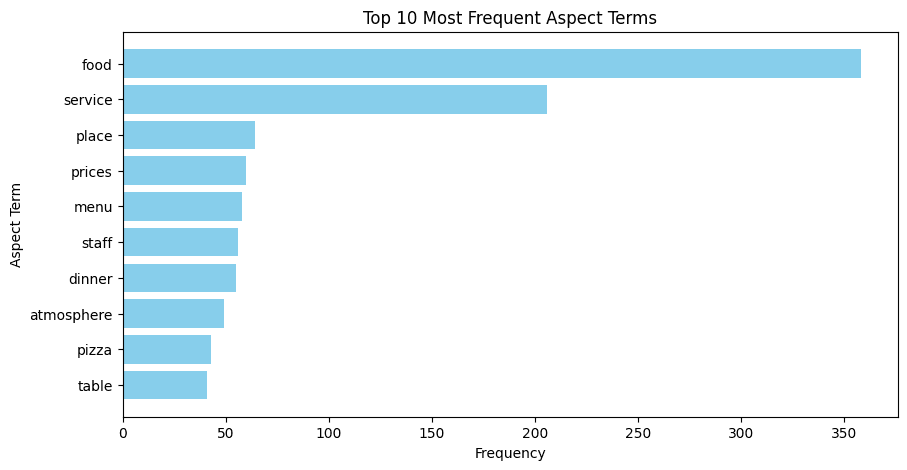
Experiments used the SemEval-2014 restaurant and laptop review datasets — two domains with different vocabularies. In the restaurant training data, a handful of aspects such as food and service dominate (Fig. 5).
Reported results
What the report found
| Instruction-tuned model | ATE · F1 (%) | ASC · accuracy (%) | ||
|---|---|---|---|---|
| Res14 | Lap14 | Res14 | Lap14 | |
| Mistral 7B | 95.40 | 92.89 | 89.29 | 82.76 |
| Llama 3 8B | 94.03 | 91.89 | 88.57 | 81.50 |
In the reported configurations, Mistral 7B scored slightly higher than Llama 3 8B on both tasks and both datasets, and both models found the laptop domain harder, particularly for sentiment classification. These are comparisons between the two configurations in the study; no claim is made about state-of-the-art standing.
The repository
What survives, and what doesn't
The public repository is incomplete. It does not contain the final training code for the Mistral and Llama 3 configurations above — those results are documented in the report. What it does retain are earlier experiments: Llama 2 7B fine-tuned with QLoRA on a joint task (extracting aspects and their polarity together), zero-shot baselines, and dataset exploration.
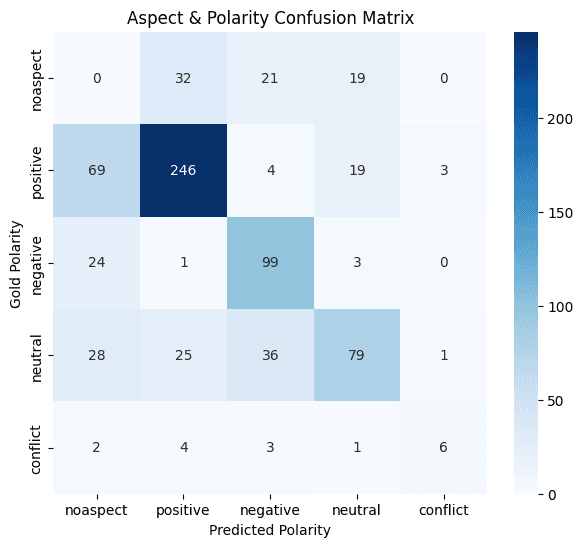
Those earlier notebooks are useful context in their own right. The zero-shot base model scored close to zero F1 on the joint output format, while the fine-tuned Llama 2 model reached a micro-F1 of 0.69 on Laptops14 — a reminder of how much of the gain comes from teaching the model the task's structure.
Scope
How to read this work
Technologies
Stack
- Modelling
- Python, PyTorch, Hugging Face Transformers
- Fine-tuning
- PEFT, QLoRA (4-bit), SFT
- Models
- Mistral 7B Instruct, Llama 3 8B Instruct, Llama 2 7B (earlier)
- Data
- SemEval-2014 Restaurants, SemEval-2014 Laptops