Customer Retention Prediction
An end-to-end churn model: exploratory analysis of 7,043 customer records, compared and tuned ensemble classifiers, MLflow tracking, and a FastAPI and Gradio service with tests for training–serving consistency.
- Focus
- Machine Learning, MLOps
- Core stack
- XGBoost, MLflow, FastAPI
- Recall
- 94.1%
- Precision
- 42.2%
- ROC-AUC
- 0.849
Framing
Which mistake costs more?
The question
Given a telecom customer's account, services and billing details, how likely are they to leave? A model that flags likely churners lets a retention team act before the customer goes.
The trade-off
Missing a customer who leaves is usually costlier than contacting one who would have stayed. That makes recall the priority — and makes the decision threshold, not just the model, a design choice.
Exploration
What the data says first
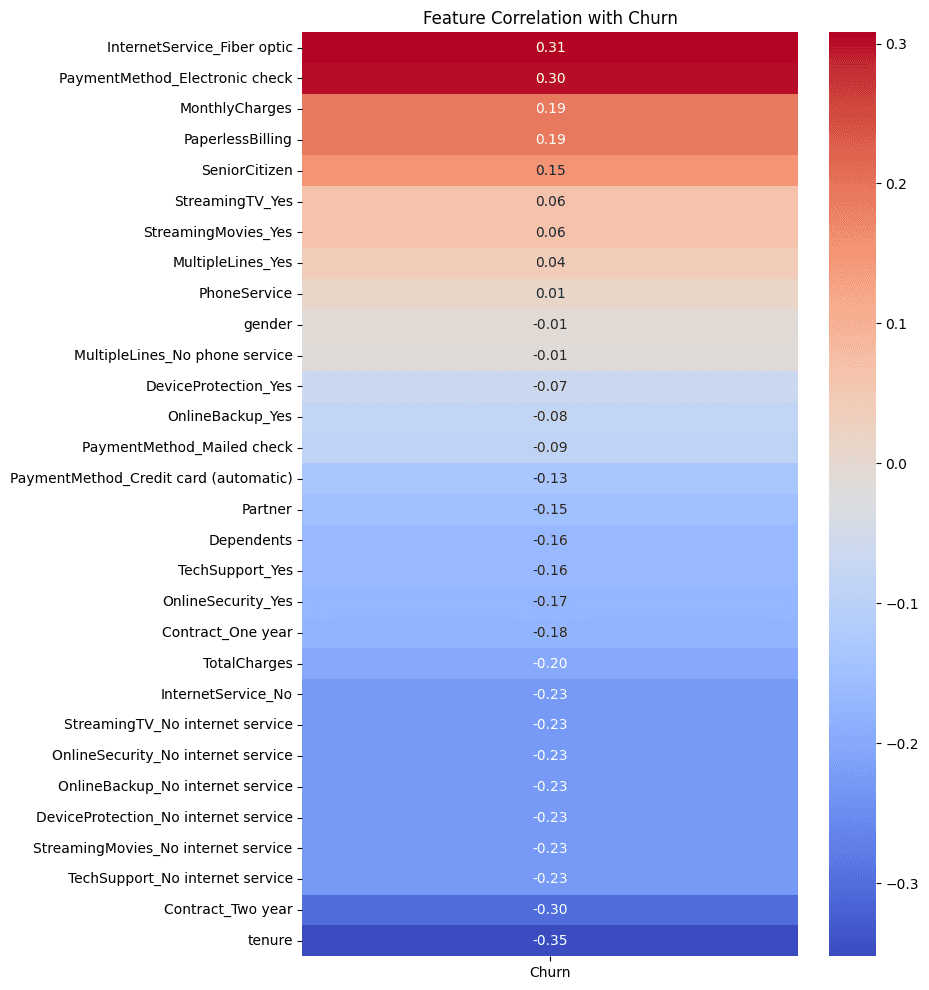
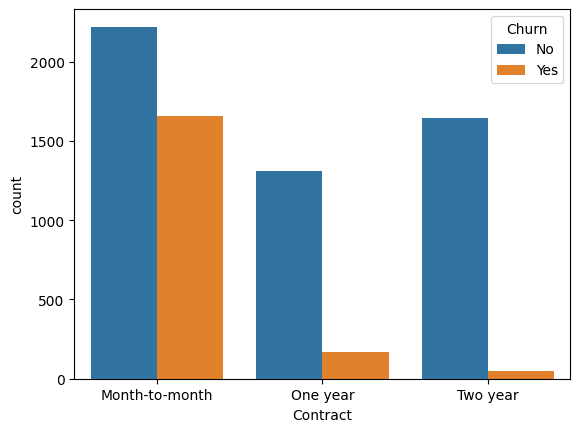
Exploratory analysis of the 7,043 records shows the classes are imbalanced and that churn concentrates in recognisable groups: month-to-month contracts, short tenure, fibre-optic internet and electronic-check payment are all associated with churn, while long tenure is associated with staying.
Modelling
Compare, tune, track
After validation, preprocessing and a stratified train/test split, several ensemble classifiers were compared with class imbalance taken into account. XGBoost was tuned with Optuna, and every run — parameters, metrics and the resulting model artifact — was logged to MLflow, so the served model can be traced back to the experiment that produced it.
From raw records to a served model
Diagram
Results
A recall-oriented operating point
- Recall
- 94.1%
- Precision
- 42.2%
- ROC-AUC
- 0.849
- Threshold
- 0.25
Lowering the threshold to 0.25 catches about 94% of churners, at the cost of precision: fewer than half of the flagged customers actually churn. Whether that is a good trade depends on what a retention contact costs — which is exactly why the threshold is reported alongside the numbers.
An important caveat. The Optuna objective was scored on the same test split later used to report these results, so they are optimistic and should not be read as an independent estimate of performance on new customers.
Training–serving consistency
The bug that only appeared for one customer
A prediction request for a single customer could produce the wrong feature columns. With one-hot encoding and drop_first=True, a single row only contains one category per column — so the encoder can drop exactly the column the model needs. The serving path now fixes each categorical column's levels before encoding and selects the training feature list explicitly.
Before — one request, one row
row = {"Contract": "Two year", …}
pd.get_dummies(df, drop_first=True)

# only one category is present, so
# drop_first drops it — the column
# the model expects never appears
After — levels fixed up front
df[col] = pd.Categorical(
    df[col], categories=LEVELS[col])
X = pd.get_dummies(df, drop_first=True)
X = X[FEATURE_COLS]

# same columns for 1 row or 10,000Serving
An API and an interface
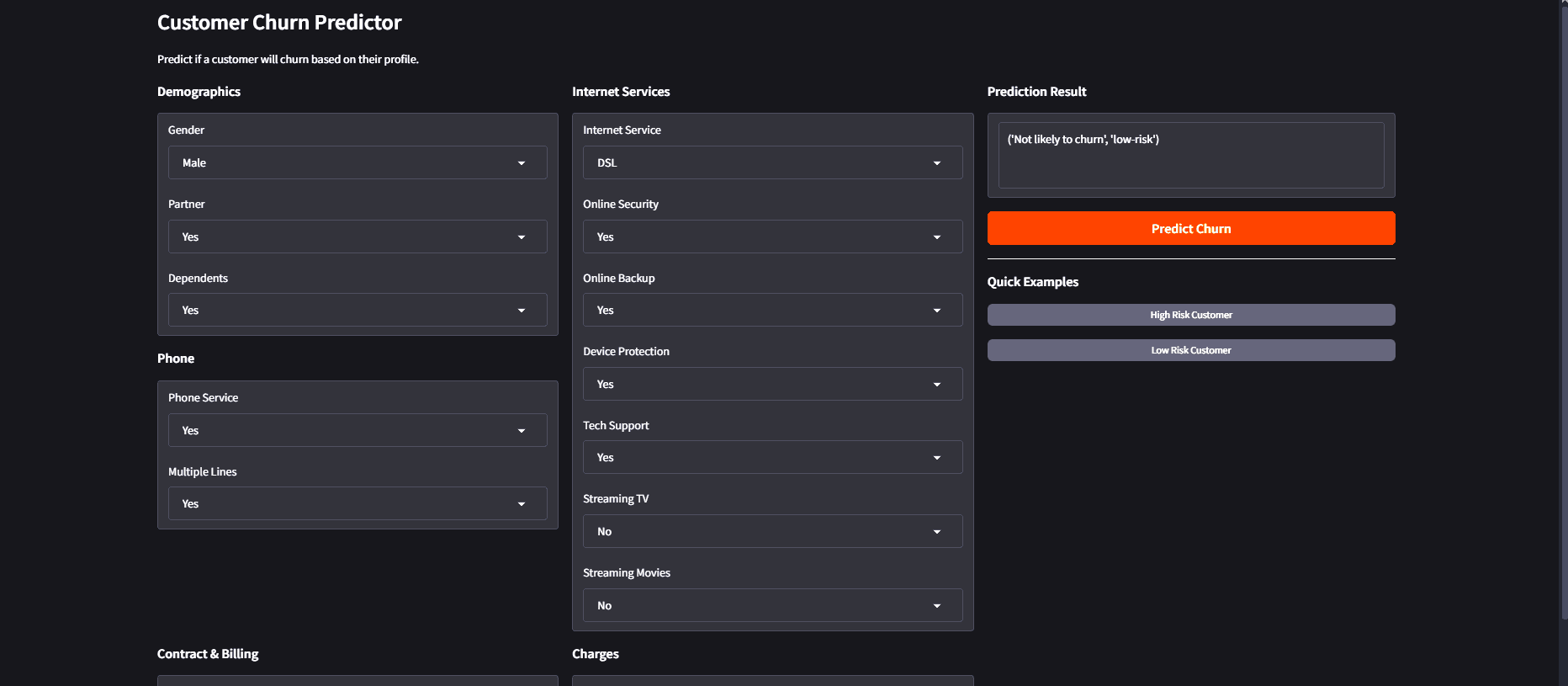
The MLflow model is served behind a FastAPI /predict endpoint, with a Gradio interface mounted on the same app for manual testing. A CI workflow builds and publishes the Docker image.
Limitations
Read the numbers with these in mind
Technologies
Stack
- Modelling
- Python, Pandas, scikit-learn, XGBoost, LightGBM, Random Forest
- Experimentation
- Optuna, MLflow
- Serving
- FastAPI, Gradio
- Engineering
- pytest, Docker, GitHub Actions